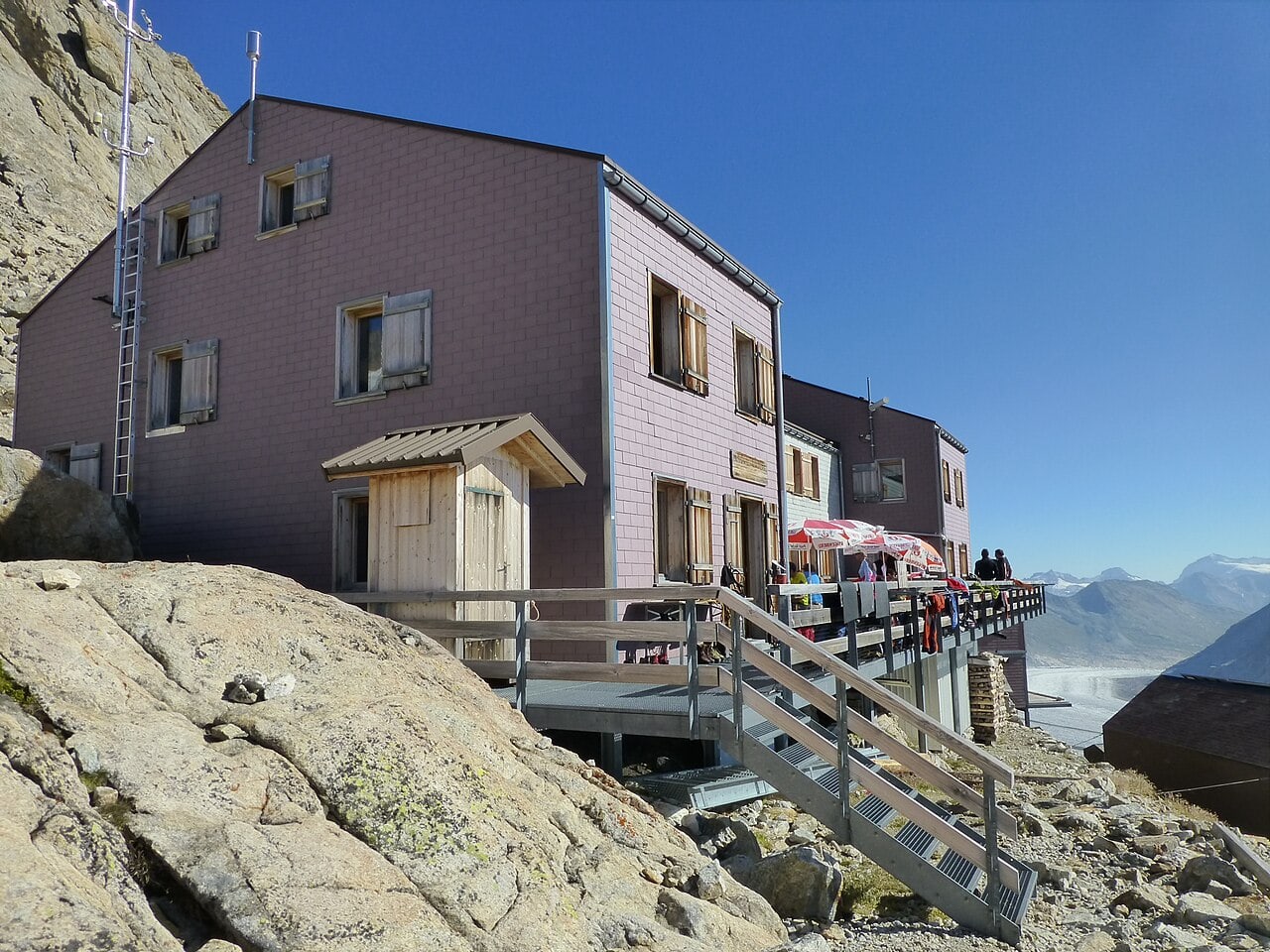
🧭 The hut at a glance
The Konkordiahütte is perched at 2,850 m above the Konkordiaplatz, in the middle of the Jungfrau-Aletsch UNESCO World Heritage Site – where the firn fields of the Jungfrau, Aletsch and Grünhorn merge into the Great Aletsch Glacier. With 155 beds it is the largest hut of the Swiss Alpine Club and belongs to the SAC Grindelwald section. A first, small hut stood here as early as 1877; because the glacier has retreated, today’s hut now sits some 200 m above the ice surface and is reached by a metal staircase of 526 steps.
🛏️ Beds
- 155 beds, with additional beds in the neighbouring Haslerhütte when occupancy is high
- Most beds are equipped with pillows and duvets
- A silk or cotton sleeping bag liner is compulsory
- Open in spring (mid-March to the end of May) and in summer (mid-June to mid-September)
- Booking strongly recommended – this is one of the most visited huts in Switzerland
- Webcam running around the clock
🍽️ Services
- Catering and half board
- Water supply from a meltwater reservoir of around 70,000 litres – roughly 9 litres per guest per day
- Solar power for lighting and infrastructure
- A climbing crag and a three-pitch sport route close to the hut
- Terrace with panoramic views of the Konkordiaplatz and the Jungfraujoch
⭐ What makes the Konkordiahütte special
- The largest SAC hut – a central base in the middle of the biggest glacier in the Alps
- The legendary 526-step metal staircase from the glacier up to the hut, now a landmark in its own right
- Starting point for classic alpine tours such as the Jungfrau, Mönch, Aletschhorn, Gross Grünhorn and Äbni Fluh
- A key stage on glacier treks and ski traverses between the Grimsel Pass, the Jungfraujoch and the Lötschental
- Connections to further huts via the Grünhornlücke (Finsteraarhornhütte), the Grosser Aletschfirn (Hollandiahütte) or the Jungfraufirn (Mönchsjochhütte)
- Over 145 years of history on the same site, extended and modernised many times since
- An awe-inspiring natural spectacle: a setting at the heart of the Jungfrau-Aletsch UNESCO World Heritage Site